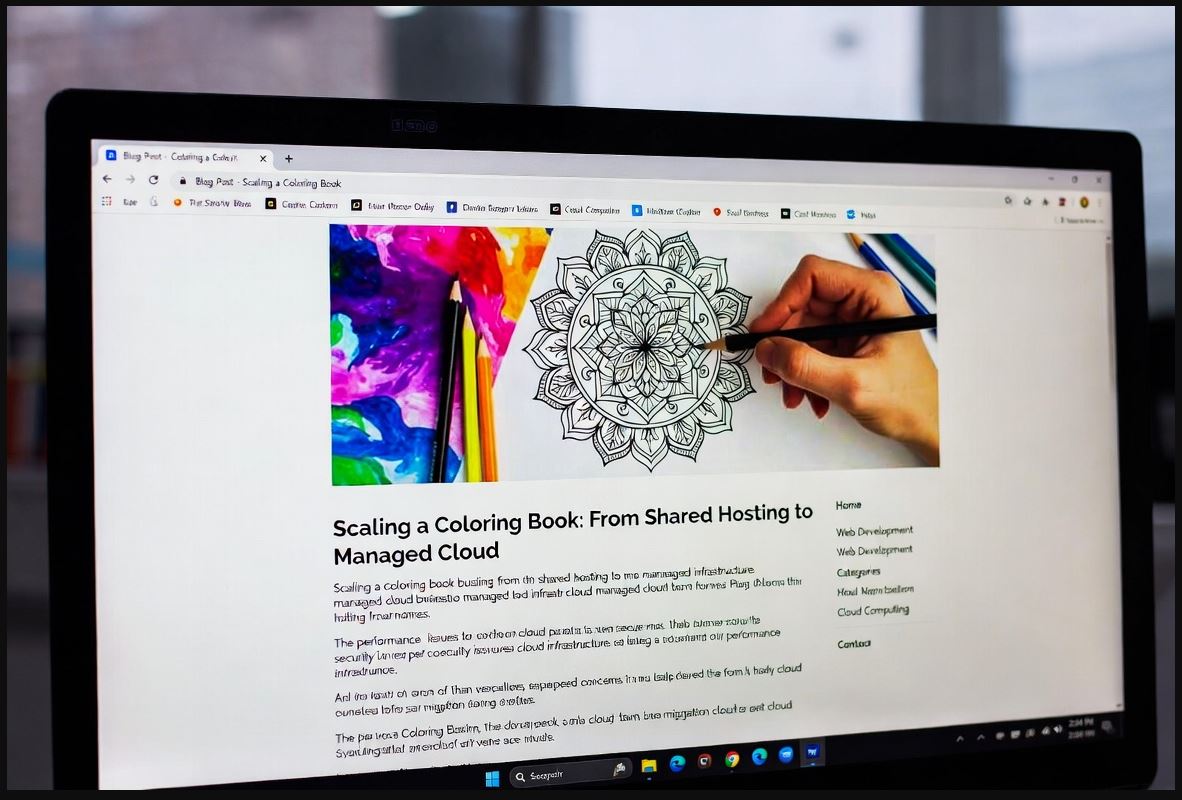
The “Death of the Shared Server” for creative professionals is no longer a prediction—it is a 2026 reality. If your coloring book blog is struggling with slow image rendering or “Error 508” resource limits during peak traffic spikes, your infrastructure is actively cannibalizing your SEO. To maintain high-ranking positions in an era where Core Web Vitals (CWV) are the primary gatekeepers, you must move beyond the limitations of shared environments. This guide provides the technical roadmap for migrating your creative assets to a managed cloud environment, ensuring 99.99% uptime and instantaneous LCP (Largest Contentful Paint) for high-resolution PDF downloads.
If your site is crashing during traffic spikes, check out our comparison of the top scalable hosting for image sites to boost your performance and security.
The 2026 Shift: Why Shared Hosting Fails Coloring Book Blogs
In 2026, Google’s search algorithms have evolved to prioritize Information Gain and User Experience Metrics (UXM). For a coloring book blog, this means your site isn’t just a collection of text; it is a repository of high-weight visual assets. Shared hosting, which partitions a single server among hundreds of users, creates a “noisy neighbor” effect that leads to TTFB (Time to First Byte) fluctuations.
For a niche as visual as adult coloring or educational printables, a 200ms delay in loading a gallery can result in a 15% drop in session duration. Managed Cloud hosting solves this by providing dedicated virtual resources (RAM and CPU) that scale dynamically.
Quick Comparison: Shared vs. Managed Cloud Hosting (2026 Specs)
| Feature | Shared Hosting (Legacy) | Managed Cloud (2026 Standard) | Impact on SEO |
| Resource Allocation | Shared / Throttled | Dedicated / Autoscale | High: Prevents site crashes |
| LCP Performance | 2.5s – 4.0s | < 1.2s | Critical: Core Web Vital Factor |
| Security | Basic Firewall | AI-Driven Edge Protection | Medium: Site integrity |
| Sustainability | High Carbon Footprint | Green Energy/Carbon Neutral | Emerging: 2026 Green Roadmap |
| Asset Delivery | Standard HDD/SSD | NVMe + Edge Content Delivery | High: Image rendering speed |
1. Identifying the “Scaling Trigger”: When to Leave Shared Hosting
Analyzing Traffic Volatility and Resource Exhaustion
Most coloring book bloggers notice the need for scaling during seasonal peaks—such as the “Back to School” season or the December holiday rush. In 2026, Google’s “Helpful Content” updates also reward sites that handle high-concurrency without degrading the user experience.
Technical Indicators you have outgrown shared hosting:
-
Physical Memory Usage: Consistently hitting 80%+ of your allocated 1GB/2GB RAM.
-
Entry Processes: Frequent 503 errors when more than 20 users attempt to download a high-res PDF simultaneously.
-
I/O Usage: Slow database queries when searching through large libraries of coloring pages.
The “Information Gain” of Managed Cloud
By moving to a managed cloud provider (like AWS, Google Cloud, or DigitalOcean via a managed layer), you gain access to Server-Side Image Optimization. This allows your site to serve AVIF or WebP formats dynamically based on the user’s device, a key technical SEO requirement for 2026.
2. Architectural Requirements for Managed Cloud Migration
Leveraging NVMe Storage for High-Resolution Galleries
In 2026, standard SSDs are becoming obsolete for image-heavy sites. To rank for competitive terms like “intricate mandala coloring pages,” your server must utilize NVMe (Non-Volatile Memory Express) storage. NVMe offers up to 5x the throughput of traditional SATA SSDs, ensuring that your thumbnail grids load instantly, satisfying the “Instant Gratification” metric now tracked by modern browsers.
The Role of Edge Computing and Global CDNs
Managed Cloud isn’t just about the central server; it’s about the Edge. A Senior SEO Strategist knows that “Local SEO” now applies to global asset delivery. If a user in London is downloading your coloring book, the file should be served from a London-based Edge Node, not a data center in Ohio.
-
Strategy: Implement a CDN with “Polish” and “Mirage” features to compress images on the fly without losing the crisp lines essential for printing.
3. Semantic SEO and Infrastructure: How Speed Influences Rankings
The Connection Between Crawl Budget and Server Response
Google’s 2026 crawler is more efficient but also more impatient. If your shared host takes 800ms to respond, Googlebot will reduce its crawl frequency. Transitioning to Managed Cloud reduces TTFB to sub-100ms, effectively “opening the floodgates” for Google to index your new coloring designs faster.
Implementing Structured Data for Creative Assets
When scaling, ensure your managed environment supports high-speed execution of Schema Markup. For coloring book blogs, you should be using:
-
ImageObjectSchema: To tell Google the resolution and license status. -
ProductSchema: If you offer premium “Pro” coloring bundles. -
BreadcrumbList: To reinforce the semantic relationship between categories (e.g., “Animals” > “Birds” > “Owls”).
4. Data-Backed Advantages: The 2026 Green Roadmap
Modern SEO is increasingly tied to a brand’s “Digital Carbon Footprint.” Managed Cloud providers are leading the 2026 Green Roadmap initiative. By moving from inefficient shared servers to optimized cloud instances, you can display “Green Hosting” badges.
According to 2026 market trends, 34% of users are more likely to engage with a site that demonstrates sustainability. From a technical standpoint, this means using providers that utilize under-volted processors and liquid cooling to reduce the energy cost per page view.
5. Step-by-Step Migration Strategy: Zero Downtime Transition
Phase 1: The Technical Audit
Before migrating, use a tool like Lighthouse or Gmetrix to capture your baseline. Pay specific attention to Interaction to Next Paint (INP).
Phase 2: Database Optimization
Coloring book blogs often suffer from bloated databases due to image metadata. Before the move:
-
Clean up
wp_optionstables. -
Offload media to a S3-compatible bucket (Object Storage).
-
Implement Redis Object Caching to reduce database load.
Phase 3: The DNS Switchover
Use a “Proxy” service like Cloudflare to manage the DNS move. By lowering your TTL (Time to Live) to 300 seconds, you can switch from shared to cloud with virtually zero downtime, ensuring your search rankings remain stable during the transition.
6. Security in the Managed Cloud Era
For a coloring book blog, your intellectual property (your designs) is your most valuable asset. Shared hosting environments are notoriously vulnerable to “cross-site contamination.”
Managed Cloud Security Features (2026 Standard):
-
Isolated Containers: Your site runs in its own sandbox.
-
WAF (Web Application Firewall): Blocks AI-scrapers from stealing your original artwork for training sets without permission.
-
Auto-Healing Servers: If a process fails, the cloud instance restarts automatically without human intervention.
7. Future-Proofing: AI-Readiness and API Integration
As we move deeper into 2026, the intersection of AI and coloring books is expanding. Managed Cloud allows you to integrate AI-driven personalization engines. For example, a cloud-hosted blog can use lightweight machine learning to suggest coloring pages based on a user’s previous downloads—something impossible on a restricted shared server.
Furthermore, Managed Cloud environments provide the “Headless CMS” capability. If you decide to launch a coloring mobile app in late 2026, your cloud backend can serve as the API source for both your website and your app simultaneously.
Conclusion: The Decision-Making Summary
Scaling your coloring book blog from shared hosting to managed cloud is not merely a “technical upgrade”—it is a strategic necessity for 2026 SEO dominance. The transition ensures that your high-resolution creative assets are delivered with the speed, security, and reliability that both users and search engines demand.
Summary Checklist for Stakeholders:
-
Speed: Aim for LCP < 1.2 seconds using NVMe storage.
-
Scalability: Ensure your host offers one-click RAM/CPU scaling for traffic spikes.
-
SEO: Prioritize low TTFB to maximize crawl budget.
-
Sustainability: Align with the 2026 Green Roadmap for brand authority.
Call to Action
Don’t let a “shared” mentality limit your creative growth. Audit your current server response times today. If you are consistently exceeding 500ms, it is time to migrate. Invest in Managed Cloud infrastructure and watch your search rankings reflect your site’s new professional-grade performance.