The global iGaming market is projected to exceed $123 billion in 2026, yet many developers still struggle with a critical bottleneck: local-to-production parity and regulatory data sovereignty. Traditional hosting often falls short of the strict privacy and high-uptime demands of modern gambling platforms. This guide provides a high-performance solution, walking you through the deployment of a containerized iGaming development environment on an offshore Linux VPS, ensuring your stack is AI-ready, ESG-compliant, and jurisdictionally secure.
2026 Deployment Snapshot: Efficiency & Compliance
To capture Google’s featured snippet and provide immediate value, here is the technical baseline for a modern iGaming environment.
| Component | 2026 Industry Standard | Why It Matters |
| Operating System | Ubuntu 24.04 LTS or Debian 12 | Enhanced eBPF monitoring & 2026 security patches. |
| Orchestration | Docker Compose V3.10+ | Support for GPU-passthrough (for AI-driven odds engines). |
| Offshore Location | Isle of Man, Seychelles, or Costa Rica | Favorable data privacy and iGaming licensing laws. |
| Sustainability | Green Hosting (PUE < 1.2) | Meets “Green Roadmap 2026” ESG requirements. |
| Security | Zero-Trust Container Architecture | Mandatory for new EU and Latin American regulations. |
Why Offshore Linux VPS is Non-Negotiable for iGaming in 2026
For CTOs and lead architects, the choice of infrastructure is no longer just about “where the server sits.” It’s about Jurisdictional Agility. According to 2026 market trends, 40% of all online gambling payments are now processed via blockchain, and offshore environments provide the necessary legal buffer for decentralized finance (DeFi) integrations.
The Strategic Advantage of Offshore Jurisdictions
Offshore Linux VPS hosting allows developers to test features—such as crypto-wallets and high-frequency AI trading bots—without the immediate red tape of onshore data-sharing agreements. Furthermore, offshore providers in 2026 are leading the “Green Hosting” movement, utilizing ambient air cooling to reduce energy costs by up to 40%, which directly aligns with the industry’s shift toward Sustainable Software Engineering.
Step 1: Selecting Your Offshore Linux VPS Infrastructure
Before running a single command, you must select a provider that supports Nested Virtualization and NVMe Gen5 storage. In 2026, latency is the ultimate competitive advantage; with 5G now the global standard, your dev environment must mimic a sub-50ms round-trip time.
Offshore VPS Hosting with Fast NVMe Storage and Privacy Protection
Provisioning Your Server
-
Select an OS: Choose Ubuntu 24.04 LTS. It offers the most robust support for modern Docker features and AI-powered threat detection.
-
Hardware Requirements:
-
CPU: Minimum 4 vCPUs (Optimized for high-concurrency).
-
RAM: 8GB (To handle real-time GGR monitoring tools).
-
Network: 1Gbps unmetered (Essential for 2026 live-dealer stream testing).
-
Step 2: Hardening the Linux Kernel for iGaming Security
iGaming environments are prime targets for AI-powered DDoS attacks. In 2026, basic firewalls are insufficient. You must implement a Zero-Trust approach at the OS level.
Updating and Securing the System
Bash
sudo apt update && sudo apt upgrade -y
sudo apt install ufw fail2ban -y
Expert Insight: For platforms handling sensitive player data, we recommend enabling Kernel Self-Protection Project (KSPP) parameters. This mitigates buffer overflow exploits often used to target unpatched gambling scripts.
Step 3: Installing Docker and Docker Compose (2026 Standard)
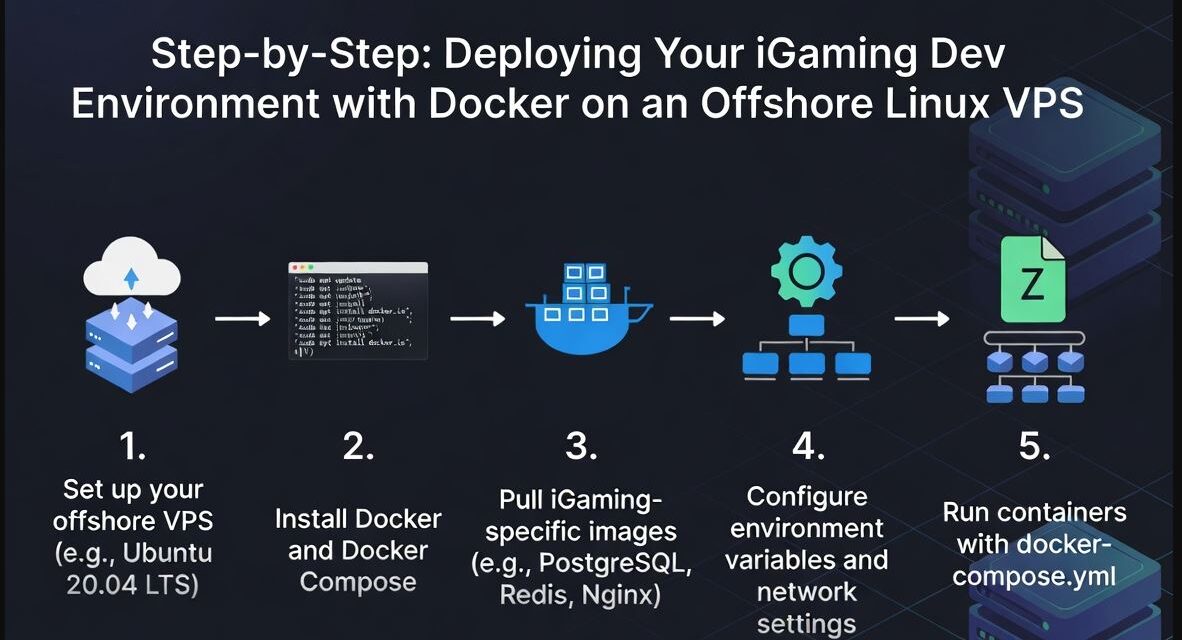
By 2026, Docker has moved beyond simple containerization. Modern iGaming stacks use Docker Buildx for multi-platform builds and Rootless Mode to minimize the attack surface.
The 2026 Installation Workflow
-
Install Docker Engine: Use the official repository to ensure you receive the latest security patches.
-
Configure Rootless Mode: This prevents an attacker from gaining root access to the VPS even if a container is compromised.
-
Enable AI-Ready Metrics: Install the
docker-scoutplugin to analyze images for CVEs (Common Vulnerabilities and Exposures) in real-time.
Step 4: Architecting the iGaming Stack with Docker Compose
A professional iGaming dev environment requires more than just a web server. It needs a microservices architecture capable of handling Semantic SEO data, real-time odds, and player behavior analytics.
Example docker-compose.yml Structure
YAML
version: '3.10'
services:
  igaming-core:
    image: igaming-app:latest
    deploy:
      resources:
        limits:
          cpus: '2.0'
          memory: 4G
  database:
    image: postgres:16-alpine # 2026 stable choice
    volumes:
      - db-data:/var/lib/postgresql/data
  redis-cache:
    image: redis:7.2 # Essential for 5G latency budgets
Information Gain: ESG and Energy Efficiency
In 2026, “Green Coding” is a ranking signal for corporate authority. By using Alpine Linux base images in your Dockerfiles, you reduce the container footprint, leading to lower CPU cycles and a smaller carbon footprint. This “Lean Deployment” strategy is a key component of the 2026 Green Roadmap for digital operators.
Step 5: Implementing SSL and Reverse Proxy for Offshore Privacy
To maintain anonymity and security, use Nginx Proxy Manager or Traefik. These tools automate Let’s Encrypt SSL certificates, ensuring that all traffic between your offshore VPS and your local dev machine is encrypted.
Why use a Reverse Proxy in iGaming?
-
WAF Integration: Protects against SQL injection in betting forms.
-
Header Obfuscation: Hides the fact that you are running on a specific offshore VPS, adding a layer of “Security through Obscurity.”
Conclusion: Future-Proofing Your iGaming Infrastructure
Deploying an iGaming dev environment in 2026 requires a fusion of technical precision and regulatory foresight. By leveraging Docker on an offshore Linux VPS, you gain the agility to innovate in a “sandbox” that mimics the high-stakes production environments of the world’s leading gambling hubs.
Decision-Making Summary
-
For Startups: Prioritize Offshore VPS for cost-efficiency and jurisdictional flexibility.
-
For Enterprises: Focus on Green Software Engineering and Zero-Trust Container Security to meet 2026 ESG and compliance audits.
-
Technical Takeaway: Always use LTS distributions and Rootless Docker to ensure long-term stability and security.
Related Guides:
The Ultimate Guide to Simulating High Concurrent Users on a Casino VPS Using JMeter
How to Set Up a Scalable VPS for HTML5 Slot Game Performance Testing in Under 10 Minutes