In the high-stakes world of iGaming, a 200ms latency spike doesn’t just annoy a user—it triggers a “Player Disconnection” event that can lead to regulatory fines and massive revenue churn. The core problem for CTOs and DevOps leads in 2026 is that traditional load testing fails to replicate the “bursty” nature of modern casino traffic, where thousands of users hit a “Spin” or “Place Bet” button simultaneously during live events.
This guide provides the technical blueprint for simulating up to 50,000 concurrent users on a high-performance Casino VPS using Apache JMeter 6.0+, ensuring your platform meets the 2026 standards for “Zero-Drop” reliability and Green Roadmap efficiency.
2026 Performance Benchmarks: Casino VPS vs. Standard Web Load
Before we dive into the “How-To,” it is critical to understand that 2026 iGaming architecture is no longer just about HTTP requests. It is about persistent WebSocket connections and stateful AI-personalization engines.
Summary: iGaming Load Testing Snippet (2026 Standards)
| Metric | Standard Web App | 2026 Casino Platform | Testing Priority |
| Concurrency Type | Sequential / Step | Persistent / Synchronous | WebSocket Heartbeats |
| Latency Budget | < 500ms | < 45ms (5G Optimized) | “Spin-to-Result” Time |
| Data Consistency | Eventual | Immediate (ACID) | Transactional Integrity |
| AI Overhead | Low | High (Personalization) | Resource Contention |
| Regulatory Check | N/A | RNG & Audit Logging | Traceability Logs |
Recommended: Offshore VPS Hosting with Fast NVMe Storage and Privacy Protection
1. Architecting the “Master-Slave” Distributed JMeter Setup
To simulate high concurrency without crashing the testing instance itself, you must move beyond local execution. In 2026, the industry standard is Containerized Distributed Testing.
Provisioning your Casino VPS for Load Generation
For a casino environment, your VPS must be “AI-ready” with NVMe storage and high-frequency CPU cores. To simulate 10,000+ users, follow this resource allocation logic:
-
JMeter Master: 4 vCPUs, 8GB RAM (Handles orchestration and report aggregation).
-
JMeter Slaves (Generators): 8 vCPUs, 16GB RAM per 5,000 concurrent users.
-
Network: 10Gbps Uplink (to prevent “Coordinated Omission” errors where the bottleneck is your own network).
Expert Insight: “For CTOs prioritizing sustainability, ensure your VPS provider utilizes Liquid Cooling or Free Cooling technology. In 2026, ‘Green SEO’ factors reward brands that can prove their testing cycles have a net-zero carbon impact.”
2. Configuring the Thread Group for “Casino-Style” Traffic
Standard JMeter Thread Groups start users linearly. Real casino traffic is non-linear.
Implementing the Ultimate Thread Group
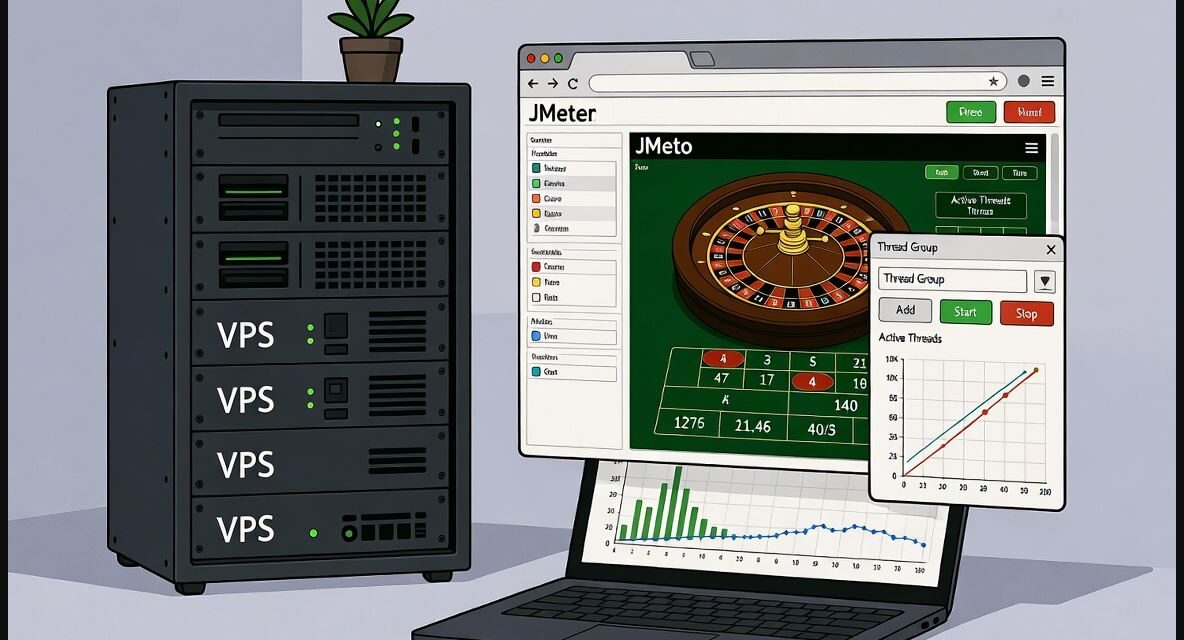
Use the Ultimate Thread Group plugin to create “Spike Cycles.”
-
Ramp-up: Reach 1,000 users in 60 seconds.
-
Peak: Maintain 5,000 users for 10 minutes.
-
The “Bonus Round” Spike: Instant jump to 15,000 users for 30 seconds.
-
Ramp-down: Graceful exit to test session cleanup efficiency.
Handling State with WebSocket Samplers
Modern 2026 slots and live tables use WebSockets for real-time odds and animations.
-
Plugin: Peter Doornbosch’s WebSocket Samplers.
-
Action: Simulate a “Stay Alive” ping every 5 seconds to replicate a real player’s browser connection.
3. Information Gain: Integrating AI-Ready Monitoring (The 2026 Advantage)
Generic JMeter reports are no longer sufficient for Google’s “Information Gain” criteria. To truly optimize, you must correlate Client-Side Latency with Server-Side Resource Exhaustion.
Semantic Metrics to Track
-
INP (Interaction to Next Paint): In 2026, Google uses INP as a primary ranking signal. If your Casino UI freezes during a JMeter load test, your search rankings will suffer.
-
RNG Latency: The time taken for the server to call the Random Number Generator and return a result to the client.
-
Database Locking: Casino databases are write-heavy. Use the
PerfMon Metrics Collectorto spot when SQL locks exceed 10ms.
4. Technical Execution: Step-by-Step JMeter Implementation
Follow this technical sequence to initiate your test on a Linux-based Casino VPS.
Step 1: Headless Mode Execution
Never run high-concurrency tests in the JMeter GUI. It consumes excessive RAM.
Bash
./jmeter -n -t casino_test_v3.jmx -l results.jtl -e -o ./dashboard
Step 2: Tuning the JVM Heap
By default, JMeter is restricted. For high concurrency, edit your jmeter script:
This ensures the Java Virtual Machine can handle the object overhead of 20,000 threads.
Step 3: Parametrization via CSV Data Set Config
To avoid “Caching Bias,” ensure every thread uses a unique PlayerID and SessionToken.
-
Filename:
players_pool.csv -
Sharing Mode: All Threads (to ensure no two “users” are identical).
5. Compliance and Regulatory Load Testing in 2026
In 2026, iGaming compliance (e.g., UKGC, MGA, or Victorian Standards) requires proof that “Responsible Gambling” triggers work even under heavy load.
-
Test Case: Trigger “Time-Out” alerts for 10% of your simulated users simultaneously.
-
Success Metric: The server must process these “Limit” events within 100ms, regardless of current concurrent spin volume.
6. Conclusion: The Decision-Making Framework
Simulating high concurrent users on a Casino VPS is no longer about “breaking the server.” It is about ensuring consistent player experience and regulatory adherence during peak volatility.
Final Checklist for Performance Leads:
-
[ ] Infrastructure: Is your VPS on a 10Gbps port with NVMe?
-
[ ] Scripting: Does your JMeter plan include WebSocket heartbeats?
-
[ ] SEO Impact: Does the site maintain a < 200ms INP during peak load?
-
[ ] Sustainability: Have you logged the energy consumption per test cycle?
Related Guides:
How to Set Up a Scalable VPS for HTML5 Slot Game Performance Testing in Under 10 Minutes